
4WD Winch: Reliability for Off-Road and Heavy-Duty Needs
Hydraulic 4WD winch reliability depends on more than the rated pulling capacity. A suitable winch must work with the vehicle's hydraulic supply, fit the approved mounting arrangement and provide the required pulling performance at the working rope layer. For equipment distributors, recovery vehicle builders and fleet procurement teams, these checks are more useful than a general claim that hydraulic winches are stronger or more reliable than electric alternatives.
This guide explains how to review pump compatibility, braking, clutch operation and installation requirements before selecting a hydraulic winch for a 4WD recovery project.
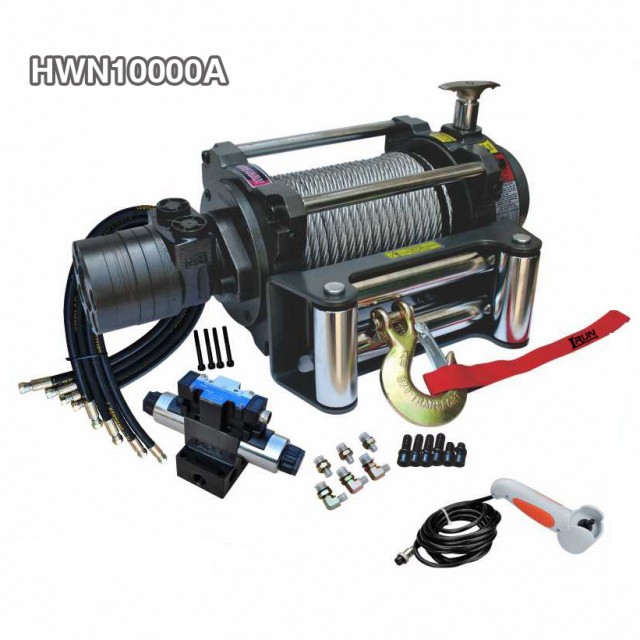
What Reliability Means for a Hydraulic 4WD Winch
A reliable installation is one that performs within documented operating conditions and can be operated, inspected and maintained as intended. The winch, hydraulic circuit, mounting structure and control system need to be assessed together.
- Hydraulic compatibility: the available supply must match the selected model's flow, pressure and circuit requirements.
- Pulling suitability: the required force must be checked against the applicable rope-layer capacity.
- Mechanical fitment: the mounting interface and surrounding structure must be suitable for the installation.
- Operational control: brake, clutch and valve functions must be understood before use.
- Maintenance access: operators need practical access to inspection points and service components.
A headline rating such as 10,000 lb, 12,000 lb or 15,000 lb does not establish all of these conditions. It is a starting point for model comparison, not a complete installation specification.
Pump Compatibility: Review Flow and Pressure Together
Use the Model's Operating Data
Hydraulic winch specifications should be reviewed as a set. Buyers need the motor displacement, required flow, pressure specification and listed performance points to assess whether the proposed hydraulic supply is suitable.
For example, the supplied specifications for three Irun Winch models list the following values:
| Model | Rated first-layer pull | Listed flow range | Listed pressure |
|---|---|---|---|
| HWX10000U | 10,000 lb | 5–45 L/min | 10 MPa |
| HWX12000U | 12,000 lb | 5–45 L/min | 11 MPa |
| HWN15000U | 15,000 lb | 5–60 L/min | 13 MPa |
These figures come from the supplied model specifications. They do not mean that every flow within the listed range produces the same line speed or pulling performance. Current technical documents should confirm the permitted operating conditions for the selected configuration.
Do Not Read Variable-Flow Tables as Constant-Flow Tests
The supplied performance tables change both flow and pressure between operating points. For the HWX12000U, the listed 12,000 lb point uses 45 L/min at 11 MPa and gives a line speed of 5.3 m/min. For the HWN15000U, the listed 15,000 lb point uses 60 L/min at 13 MPa and gives a line speed of 6.0 m/min.
These rows describe different hydraulic operating points. They should not be used to claim that line speed increases with load under an unchanged supply, or that the same speed is available from a lower-flow pump.
Confirm the Complete Hydraulic Circuit
A pump specification alone is not enough to approve an installation. The installer should review the proposed circuit and the model's current hydraulic requirements.
- Available flow and pressure at the intended connection point.
- Pressure protection and control arrangements.
- Return-line requirements, hose connections and fitting specifications.
- Cooling arrangements for the expected workload.
- Compatibility with other equipment using the same hydraulic supply.
Some supplied HWX-series feature lists mention drive from an existing power-steering pump. This is a possible arrangement requiring vehicle-specific assessment, not universal compatibility. A shared steering circuit must not be approved solely because the winch is described as suitable for 4WD vehicles.
Brake and Clutch Checks Before Recovery Work
Confirm the Brake Type and Operating Instructions
The listed HWX10000U, HWX12000U and HWN15000U models use automatic screw-cone braking. This identifies the brake feature, but it does not replace the operating manual or establish suitability for every load-handling task.
Procurement teams should request clear instructions covering brake operation, inspection and maintenance. Without a model-specific explanation, buyers should not assume exactly when the brake engages or how it interacts with the valve and transmission.
- Confirm the permitted pulling procedures.
- Review brake inspection and maintenance requirements.
- Identify any restrictions on operation or load handling.
- Keep the application within the stated pulling and recovery use.
The supplied product information explicitly excludes lifting. These winches must not be used to lift or suspend loads, and a recovery winch is not a substitute for independent transport load restraints.
Check Clutch Access and Configuration
Clutch requirements vary by model. The HWN15000U feature list describes manual, pneumatic or combined manual and pneumatic free-spooling options. The HWX-series information instead describes a clutch and speed-shift structure with automatic engagement of clutch and two-gear actions.
These descriptions should not be treated as interchangeable. Confirm the selected mechanism, operator access and engagement procedure for the exact model. Shifting or disengagement under load must not be assumed to be permitted.
Rated Pull Changes with the Rope Layer
One of the most important selection checks is whether the quoted pulling capacity applies to the first rope layer or another drum position. The supplied model tables show lower line pull as additional layers build up on the drum.
| Rope layer | HWX12000U listed pull | HWN15000U listed pull |
|---|---|---|
| 1 | 12,000 lb | 15,000 lb |
| 2 | 9,563 lb | 12,120 lb |
| 3 | 7,949 lb | 10,168 lb |
| 4 | 6,801 lb | 8,757 lb |
The practical consequence is straightforward: a 12,000 lb or 15,000 lb model should not be assessed as delivering that headline capacity at every rope position. Review the intended pulling conditions together with the layer table and operating instructions.
For individual model details, see the HWX12000U hydraulic winch and the HWN15000U hydraulic truck winch.
Installation Checks for the Exact Model Version
Use the Current Model-Specific Drawing
Products within the same capacity range may have different dimensions, weights or configurations. The supplied A- and U-version comparison tables, for example, list different heights. A drawing for a related model should not be substituted without confirmation.
- Confirm the complete model number and version suffix.
- Verify overall dimensions and the mounting bolt pattern.
- Check clearance for rope routing, hydraulic connections and controls.
- Ensure the selected clutch remains accessible after installation.
- Have the mounting structure and fastener requirements reviewed by the responsible installer.
Where a product listing contains conflicting dimensions, resolve the discrepancy before fabricating a mounting plate or modifying the vehicle. The approved installation drawing should take priority over an unverified summary.
Separate Valve Voltage from Drive Type
For the HWX12000U, the supplied DC 12V or 24V option refers to electric valve control. It does not make the product an electric-drive winch. Hydraulic supply and electrical control requirements must be specified separately.
For other models, confirm the meaning of any electrical option rather than transferring an explanation from a similar product. Wired and wireless remote control availability should also be itemized in the order configuration.
Which Reliability Claims Need Supporting Documents?
Features such as waterproof ratings, temperature limits, overload protection and continuous-duty capability should be linked to specific models and supporting documentation. A general description of hydraulic winches does not establish those capabilities for every product.
- Environmental protection: request the applicable rating and test evidence where required.
- Workload limits: confirm permitted operating duration and thermal requirements.
- Safety functions: identify the actual brake, control and protection features supplied.
- Compliance: verify document scope, model coverage and applicability to the destination market.
- Accessory scope: confirm which valves, hoses, fittings and controls are included.
This approach keeps procurement decisions tied to verifiable information. It also avoids treating a company's general certifications or manufacturing capabilities as proof of every model-specific feature.
A Practical Procurement Checklist
Before approving a hydraulic 4WD winch, assemble a model-specific review package. The following information helps the manufacturer and installer assess the same configuration:
- Vehicle platform, intended recovery task and expected pulling conditions.
- Selected model, applicable rope-layer capacity and required rope configuration.
- Available hydraulic flow, pressure and proposed circuit arrangement.
- Installation drawing, mounting clearance and structural requirements.
- Brake, clutch, valve and remote control configuration.
- Complete accessory list, operating manual and maintenance instructions.
- Required quantity, OEM requests, delivery requirements and applicable compliance documents.
The hydraulic 4WD winch category provides a starting point for comparing available models. Final selection should be based on the confirmed configuration and installation requirements.
Frequently Asked Questions
Are hydraulic 4WD winches always more reliable than electric winches?
No single drive type establishes reliability for every application. Compare the actual model, available power supply, workload, installation requirements and maintenance arrangements. Hydraulic drive alone does not guarantee unlimited duty or universal vehicle compatibility.
Can the vehicle's existing hydraulic pump be used?
Possibly, but the available flow, pressure and circuit arrangement must be checked against the winch requirements. Existing power-steering pump use requires vehicle-specific assessment, including the steering system's needs.
Why does pulling capacity change across rope layers?
The supplied model tables specify different capacities for different drum layers. Buyers should use the listed capacity at the intended working rope position, rather than applying the first-layer rating to every condition.
Does a DC 12V valve mean the winch is electrically driven?
No. Where the specification identifies DC 12V or 24V electric valve control, that voltage applies to the control component. The winch's pulling drive remains hydraulic.
Can a hydraulic recovery winch be used for lifting?
The models discussed here explicitly exclude lifting use. They must not be used to lift or suspend loads.
What should be confirmed before placing an OEM order?
Confirm the model, controls, accessories, approved branding and packaging scope, quantity, lead time and required documents. Structural or hydraulic modifications should be reviewed separately rather than assumed to be standard OEM options.
About Irun Winch
Established in 1997, Zhejiang Jinhua Runye Tech. Co., Ltd. (Irun Winch) specializes in the research, development and manufacture of vehicle winches and off-road accessories. Its range includes hydraulic, electric and industrial winches for recovery, towing and engineering applications. The company's manufacturing resources include precision machining equipment, winch test systems and motor testing equipment, and it provides OEM service for international buyers.
Information to Prepare for a Configuration Review
For a hydraulic winch selection or OEM inquiry, provide the vehicle application, required quantity, available pump flow and pressure, mounting information and preferred control arrangement. Include any branding, packaging, sample or technical documentation requirements. These details help define a model-specific quotation and reduce uncertainty about fitment and supplied components.

